OCR Quality Control: Why Accuracy Matters More Than Ever Now
In today’s fast-moving business environment, organizations depend on efficient document processing to support operations, compliance, and customer service. The shift to digital information isn’t just a matter of workflow speed – it introduces new expectations about data accuracy. If your OCR output is riddled with errors, your digital transformation may lead to costly setbacks, missed information, or even compliance issues. At ARC, we’ve seen how even small gaps in accuracy can slow down processes and demand extra rework. That’s why achieving the most reliable OCR results is a top priority for every document imaging project we manage.
Increasingly, clients turn to us because they recognize how crucial precise data capture is. Whether you are converting legacy archives or supporting an ongoing operation, having trustworthy digital documents enables your team to quickly locate, analyze, and use information. The higher the fidelity of your scanned and extracted data, the less time your staff will spend double-checking or manually correcting digital records. In fields such as finance, legal, and healthcare, even minor discrepancies can undermine confidence in documents or delay time-sensitive activities.
What Sets High-Quality Document Imaging Apart
Document imaging and graphic production services go beyond the basic act of scanning paper pages. Our services are structured to deliver searchable, high-quality digital files that are ready for immediate use. This involves more than pressing “scan” – it requires paying attention to the details that affect image clarity and data extraction. At ARC, we utilize advanced scanning technologies, apply targeted settings, and depend on a skilled team to manage each stage from preparation to image review.
Our process includes careful handling of your original documents, from the removal of staples to the repair of minor tears, so every page passes through equipment smoothly. We configure scanning hardware to capture documents at the best resolution (often 300 DPI or above), adapt to the types of materials we receive, and monitor for consistent output. This comprehensive approach means that our clients receive digital files that are not only visually accurate, but also optimized for OCR engines, which helps reduce common text recognition errors. We stand behind every digital file because we understand that our work supports core business functions.
Understanding the OCR Quality Assurance Checklist
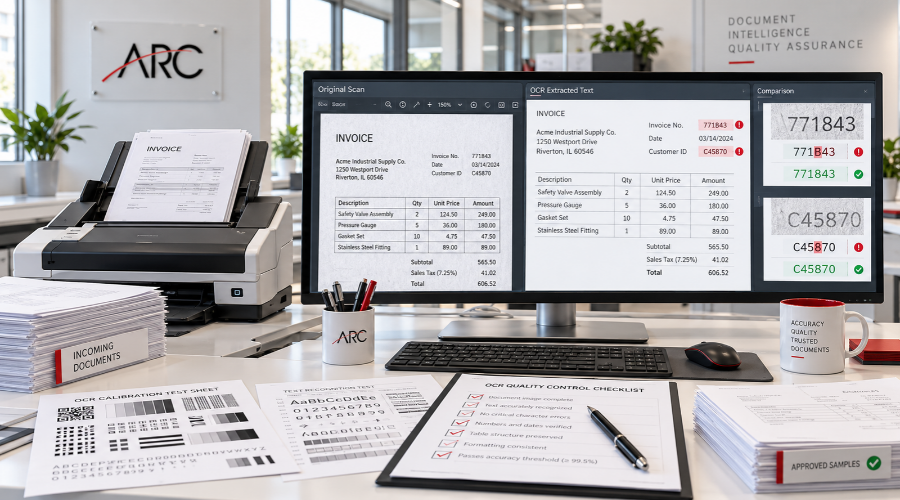
An effective document imaging process should result in digital files you can trust. To reach this goal, we rely on a structured OCR quality assurance checklist to review our work systematically, minimize errors, and confirm that digital output matches the original documents as closely as possible. This checklist is not just best practice – it’s informed by respected sources like the NIST Guide to OCR and the AIIM Industry Watch. Using these principles, we ensure each conversion meets both industry expectations and your organization’s requirements.
With this approach, our clients benefit from a transparent, repeatable process – one where accuracy and consistency are built into every project. The OCR quality assurance checklist supports compliance requirements and project deadlines by reducing the need for costly downstream corrections. Ultimately, this means you receive digital content that is ready to power search, retrieval, and business intelligence activities immediately.
The Benefits of a Robust OCR Quality Assurance Checklist
Investing in a thoughtful OCR quality assurance checklist ensures seamless document imaging projects from start to finish. By establishing clear standards and structured checkpoints, we can avoid common errors that often undermine data reliability. It’s essential to remember that the smallest inaccuracies – such as an incorrect number, date, or name – can have far-reaching effects on business processes. For this reason, implementing a robust, repeatable checklist paves the way for more accurate and reliable digitized documents.
One major advantage is the prevention of misreads and formatting inconsistencies, which can drastically reduce the number of manual corrections required after scanning. Moreover, with a defined checklist, our team can streamline the verification process, identify issues early, and ensure errors are fixed before delivery. This approach not only reduces costs and turnaround times but also helps to maintain stakeholder confidence throughout large-scale imaging efforts.
Additionally, a quality assurance checklist can act as a communication tool between internal teams and clients. It provides a transparent reference to confirm each step, sets expectations, and supports compliance with industry standards. Because many organizations rely on timely, error-free records for audits or legal requirements, having a proven, checklist-driven process is invaluable. In turn, our clients benefit from increased efficiency and less re-work, ultimately leading to better project outcomes and peace of mind.
Key Steps in the OCR Quality Assurance Checklist: Ensuring Every Page Counts
Careful planning and execution are the cornerstones of trustworthy document imaging. Our checklist-driven approach breaks down the process into manageable, high-impact steps that address potential quality issues at every stage. By following these steps, we work to deliver precise, search-ready documents every time.
Pre-Scan Document Preparation
- Remove staples, paper clips, and bindings to ensure smooth feeding and prevent jams.
- Repair torn or creased sheets so that each page is scanned completely.
- Sort documents by size and type for consistent scanner settings and optimal results.
Attention to preparation reduces the likelihood of repeated scans and ensures that every image captured is as clear as possible. As a result, the OCR software receives the best input, minimizing the need for secondary correction.
Optimal Scanning Settings and Processing
After our team preps the documents, we configure scanner settings according to the needs of the project. Document type, text size, and image quality all factor into decisions about resolution (DPI), grayscale or color selection, and filters such as deskew or de-speckle. These adjustments make a significant difference in the performance of OCR engines. By standardizing these parameters, we promote overall consistency and accuracy down the workflow pipeline.
Once scanning is underway, we use the OCR quality assurance checklist to verify output. The checklist includes random or systematic spot-checking of images for clarity and orientation. At this point, correction of skewed, cut-off, or blurred images occurs, if needed. Additionally, we audit text recognition for errors based on a set percentage of total pages.
Because our process places quality review checkpoints at multiple stages, we can spot issues quickly and resolve them without having to repeat entire batches. In many cases, this proactive approach lowers project costs by reducing the amount of manual validation and revision required after scanning.
By working systematically, we support client objectives and facilitate smoother, faster handoffs for downstream processing – whether that involves digital archiving, content management, or further review. Each step serves a specific goal in maximizing OCR accuracy and minimizing data risk, making the checklist an essential part of every engagement.
Conclusion: Making Every Scan Count with an OCR Quality Assurance Checklist
At ARC, we understand that accurate document imaging is no longer a luxury – it’s a competitive necessity. Each project, whether for healthcare, finance, legal, or any other sector, requires a commitment to precision that starts long before the first scan and continues through every verification step. With a proven document scanning approach and a dedicated OCR quality assurance checklist, we help businesses achieve reliable, usable, and compliant digital records.
Why Our Checklist Protects Your Information Assets
Our OCR quality assurance checklist isn’t just a finishing touch – it’s integral to every phase of the workflow. It guides our teams to flag common OCR pitfalls, such as missed characters or skewed formatting, before delivering the final files. We routinely audit the output, match scans against originals, and test for complete text searchability. Accuracy is at the center of each decision, from blank page detection to image orientation and batch organization.
The Lasting Value of Sound Quality Controls
Investing in a professional service that prioritizes an OCR quality assurance checklist can prevent routine mistakes from becoming costly setbacks. High accuracy from the outset supports secure data storage, simplifies compliance processes, and reduces manual data correction later. Our clients gain peace of mind, knowing their information is easy to find, share, and trust – meeting both internal and regulatory expectations.
Moving Forward with Reliable Imaging & Production Services
With ever-higher document volumes and increasing scrutiny on data integrity, the right partnership matters. We combine careful preparation, leading scanning technologies, and a structured quality assurance checklist to transform even the most complex paper archives into dependable digital resources. When you work with us, each step is managed with care – so your digital transition is smooth and the finished product delivers on accuracy, usability, and future-proofing.
Let’s Raise the Bar for Your Digital Transformation
If dependable output, complete data capture, and operational efficiency are priorities for your organization, it’s time to put a proven OCR quality assurance checklist to work. Reach out today to explore how our document imaging and graphic production services can support your next project and deliver the consistent results you expect.
FAQ
What types of documents can ARC scan and process with OCR?
We handle a wide variety of documents, including invoices, contracts, legal records, engineering drawings, blueprints, medical files, and more. Furthermore, our technology is equipped to accurately scan both standard and oversized formats, as well as bound books and fragile materials.
How does ARC ensure the highest level of OCR accuracy?
We combine the latest scanning equipment, advanced image enhancement, and multiple rounds of manual review to achieve the best OCR accuracy. Additionally, our team follows a proven quality assurance checklist customized to each project’s requirements, minimizing errors and maximizing data reliability.
Can ARC customize OCR settings for different types of documents?
Absolutely! We adjust scanning resolutions, color modes, and even language settings to meet the specific needs of your project. Moreover, because each document type may require unique treatment, our specialists collaborate with you to determine the best approach for precise results.
What is included in ARC’s OCR quality assurance checklist?
Our checklist covers every crucial step of the process: document preparation, scanner calibration, test scans, page verification, OCR accuracy sampling, error logging, and final audits. In addition, we tailor this process to the complexity and scale of each job, ensuring your project requirements are met consistently.
How quickly can ARC complete OCR scanning and conversion projects?
We pride ourselves on fast turnaround times without sacrificing quality. Project timelines depend on document volume and complexity; however, our streamlined workflows and nationwide production centers allow us to meet tight deadlines – even on large or multi-location assignments.
Do you provide secure handling and storage of sensitive documents?
Yes, we follow strict protocols to protect your data at every stage, from arrival to final delivery. For instance, we use monitored facilities, background-checked staff, and encrypted transfer methods to ensure complete security and confidentiality throughout the project.
Can ARC support regulatory compliance for industries like legal, healthcare, or finance?
We are experienced with the compliance standards in regulated industries such as HIPAA, FERPA, and SEC rules. Plus, our quality controls are designed to deliver audit-ready records, supporting your documentation and legal requirements every step of the way.
Is it possible to integrate OCR-processed documents into my existing software or document management system?
Absolutely. We deliver digitized files in a range of industry-standard formats (such as searchable PDFs, TIFF, or OCR-encoded text) that are compatible with most document management systems. Furthermore, our team can work directly with your IT group to ensure smooth integration and migration.
How does ARC handle poor-quality or damaged originals?
Even when documents are faded, torn, or smudged, our graphic technicians use specialized image correction tools and manual intervention to rescue as much data as possible. As a result, you receive clearer scans and stronger OCR output – saving you time on manual corrections.
What are the long-term benefits of partnering with ARC for document imaging and OCR?
When you work with us, you gain ongoing access to industry-leading technology, continuous process improvement, and a dedicated team invested in your success. In the long run, you’ll save on staffing costs, reduce operational risks, and future-proof your records with secure, searchable digital archives.