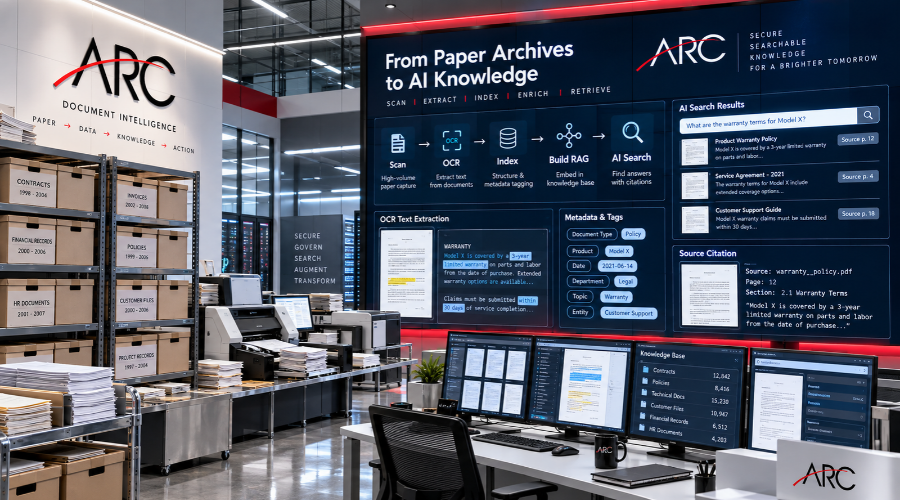
Why Digital Transformation Can’t Wait: Unlocking Knowledge with Scanned Documents for RAG
In many industries, critical information is still locked away in paper archives – schematics, contracts, as-builts, safety manuals, and more. As organizations look to improve productivity and make faster, data-driven decisions, these legacy documents can become a bottleneck. Transitioning to digital is no longer simply a matter of convenience; it’s now essential for supporting the next generation of artificial intelligence tools, including Retrieval-Augmented Generation (RAG) systems.
The Urgent Opportunity: Turning Legacy Paper Into an Intelligent Asset
Our clients often tell us about the hours spent tracking down the right paper record or searching through filing cabinets for one critical page. As demands increase for rapid access to information, these paper-based processes can’t keep up with the pace of today’s digital workflows. By digitizing these records, we turn static paper into actionable data that’s accessible right when it’s needed.
Retaining information on paper means missed opportunities – for efficiency, for compliance, and for capitalizing on the full value of accumulated knowledge. Digitization is the first and most necessary step toward creating a centralized, searchable library for your teams. When paired with advanced tools like RAG – where large language models efficiently retrieve and generate accurate responses – these digital records become even more valuable, forming the backbone of reliable, real-time knowledge sharing.
How Accurate Scanning Powers Next-Gen Retrieval-Augmented Generation (RAG) Systems
The future of intelligent document workflows hinges on the quality of your digital archive. Scanned documents for RAG systems form the basis for AI-driven search and knowledge management. However, quality matters: poorly scanned documents, misaligned pages, or inaccurate data extraction limits what your organization can achieve with automation and AI.
Our scanning process is designed to produce high-fidelity digital versions of paper documents, enabling optical character recognition (OCR) that accurately renders every word and figure. This attention to quality ensures that every piece of information – no matter how small – is available for your search tools and RAG platforms. By investing in proper scanning from the start, we help you set the stage for smarter, more precise information retrieval, reducing the risks of missed or incomplete data.
At ARC, we see the digitization of paper records as the foundation for everything that follows in enterprise AI and knowledge management. We’re committed to helping organizations unlock the full potential of their intellectual property through reliable document imaging, creating a path toward more accessible, insightful, and connected business operations.
The Benefits of Building a RAG Knowledge Base from Scanned Paper Documents
Scanned Documents for RAG: From OCR to Searchable, Accessible Data
Every organization with longstanding paper archives faces the ongoing challenge of making information accessible for modern AI-driven workflows. By converting these archives through high-quality scanning and optical character recognition (OCR), we transform physical paper into digital data that is instantly searchable and retrievable. This process enables seamless integration of even decades-old documents into retrieval-augmented generation (RAG) systems. As a result, critical insights locked in boxes or file cabinets become actionable knowledge.
When we digitize paper documents using advanced imaging and OCR, we do more than create images. We extract structured information – names, numbers, dates, and terminology – which can be indexed and connected with wider corporate data. Because this content becomes machine-readable, RAG-enabled platforms can accurately extract, reference, and generate contextual answers based on the exact wording in original documents. In turn, teams spend less time hunting for information and more time making informed decisions.
Many traditional scanning solutions stop at producing static PDFs. However, our comprehensive document imaging workflow ensures every scanned file supports advanced search features. This includes text recognition for multiple languages, quality assurance checks, and metadata tagging that allows RAG systems to pull nuanced, document-specific insights. As things change or new regulations arise, these reliable digital archives adapt, supporting compliance and operational efficiency.
Scanned Documents Enable Smarter, More Accurate Retrieval in AI-Powered Workflows
As AI adoption accelerates, the accuracy and depth of any RAG system depends on its underlying data. For organizations with a substantial physical document legacy, creating a knowledge base from scanned documents for RAG unlocks untapped value. By bridging offline information and digital analytics, we support more intelligent and informed operations.
- Reduce manual search and discovery effort by transforming paper-based materials into instantly queryable resources.
- Protect institutional knowledge; nothing is lost in moves, disasters, or risky storage conditions.
- Provide consistent, rapid answers from authoritative, original sources directly within RAG-enabled tools.
- Enhance training, onboarding, and compliance audits by making critical reference materials always available.
- Support ongoing automation and digital improvement initiatives with a foundation of high-quality, digitized content.
Furthermore, high-accuracy scanning minimizes the errors that can emerge in downstream processes. If scanning is overlooked or inconsistent, AI systems – no matter how advanced – cannot retrieve the right information or trust their sources. That’s why every step, from initial page capture to post-processing, matters in supporting data reliability.
Ultimately, pairing advanced imaging services with RAG-ready data structure allows organizations to harness powerful retrieval-augmented capabilities using their own knowledge. Teams gain confidence that even legacy paper files contribute directly to modern productivity and informed decision-making. This synergy between document imaging and AI not only streamlines operations but also ensures a smoother transition toward future digital workflows.
Why Now Is the Time to Digitize and Integrate Your Paper Archive
Organizations continue to rely on vast archives of paper-based records, manuals, drawings, and other critical information. As business demands accelerate, relying on physical documents can slow responsiveness and hinder access to important data. Now, with the advancement of artificial intelligence workflows and retrieval-augmented generation (RAG), transforming these assets into digital knowledge is more valuable than ever. Scanned documents for RAG are not only a way to preserve information, but also to empower teams to retrieve insights rapidly, minimize search times, and enable cross-functional collaboration.
Delaying the shift to a digital archive risks missing opportunities to improve productivity, reduce compliance risk, and unlock knowledge from decades of accumulated paperwork. Our experience shows that integrating high-quality, searchable scans into your existing digital ecosystem sets the stage for smarter operations and more informed decision-making. When the window to act is now, professional document imaging can be the catalyst for strategic progress.
Elevate Efficiency and Insight with Reliable Document Imaging Services
By digitizing paper archives using accurate scanning technology, we help you close the gap between analog information and digital intelligence. Our services are designed to increase efficiency by turning piles of documents into structured, indexed files ready to power RAG systems, search engines, and compliance review tools. This move is about more than just converting files; it’s about making your content work for you. Whether you need frequent retrieval of engineering plans or secure access to sensitive records, quality scanning unlocks new capabilities for your organization.
When scanned documents for RAG are integrated into your workflow, you reduce time spent on manual search or duplication of materials. Our processes ensure fidelity in data capture, so every piece of information – from handwritten notes to technical diagrams – is accessible and usable. Reliable document imaging services are a straightforward investment with measurable returns, making operations both more efficient and less prone to error.
Start Your Journey Toward a Smarter, Connected Organization Today
Adopting digital transformation is an ongoing process, but the first step is critical: capturing and converting your existing knowledge. Our team offers document scanning services that align with your workflows and support your journey from paper to actionable digital data. By collaborating with us, you benefit from careful handling of legacy records and modern techniques that make information retrieval almost instantaneous.
Now is the time to consider the future value of your documents and the possibilities of smarter, AI-driven insight. Streamline your resources and stay competitive with services specifically designed to make scanned documents for RAG a foundation for growth. Let’s work together toward a more connected, productive, and informed organization.
FAQ
How do we ensure that scanned documents are accurately converted for use in RAG systems?
We use advanced OCR (Optical Character Recognition) technologies combined with manual quality checks to ensure your scanned documents are accurately converted into searchable and accessible digital assets. This approach minimizes errors, making your data ready for Retrieval-Augmented Generation workflows from day one.
What types of paper documents can our scanning services handle?
We can digitize a wide variety of paper documents, including reports, blueprints, invoices, contracts, and even large-format files. Because our technology is flexible, we can accommodate most business and archival needs, allowing you to unlock knowledge from virtually any legacy document.
How secure is the scanning and digitization process?
Your document security is a top priority. We use encrypted, monitored workflows and secure facilities throughout the scanning process. In addition, strict access controls and compliance with industry standards safeguard your sensitive information every step of the way.
Can we customize the scanned data for industry-specific RAG applications?
Absolutely! We tailor our document imaging and data structuring services to fit your unique industry needs – whether that’s legal, healthcare, manufacturing, or beyond. This ensures the output integrates seamlessly with your RAG systems and maximizes value in your specific context.
How do digitized documents improve efficiency in AI-powered workflows?
Once your paper records are digitized, our process makes the data instantly searchable and retrievable by AI-powered systems. As a result, your teams experience faster decision-making, reduced manual data entry, and more accurate insights, empowering everyone to work smarter.
Is our scanning service suitable for companies with large and long-standing archives?
Yes, our scalable solutions are designed to handle both small batches and extensive archives with thousands of records. With efficient project management, we ensure even the largest legacy paper collections are quickly transformed into digital assets accessible by RAG tools.
How quickly can we expect to see results after starting the digitization process?
The timeline depends on the volume and complexity of your documents, but we deliver initial batches of digitized content within days. Furthermore, our teams continuously process and integrate your records, allowing you to start leveraging digital knowledge early in the project.
Do our solutions support integration with existing document management or AI systems?
We design our digitization and data structuring services for seamless integration with your current document management systems, cloud storage, and AI-powered RAG solutions. This ensures that your digital transition is straightforward and your organization remains connected throughout.
What are the sustainability benefits of digitizing paper documents?
When you shift to digital records, you reduce paper usage, save physical storage space, and lower energy consumption for file management. Consequently, our services support more sustainable operations while making your knowledge assets far more accessible and useful.
How do we maintain data quality throughout the scanning and digitization process?
We apply multi-level quality assurance checks at every stage, from initial scanning to final data validation. Our teams also address anomalies or poor-quality originals to optimize accuracy, so you can trust your digital knowledge base to be reliable for all your RAG initiatives.