Hooking Readers: Why Understanding OCR vs Intelligent Document Processing Matters Now
At ARC, we know that digital transformation continues to shape how organizations handle information. With technology driving change at every level, the pressure to manage documents efficiently grows more urgent by the day. The way we scan, capture, and process information has a direct impact on our productivity, security, and ability to deliver trusted services to our clients. Whether we’re digitizing paper archives or handling complex project documentation, the need for reliable document management cannot be overstated.
As more businesses recognize the value of automation, traditional methods like basic scanning or manual data entry are quickly becoming outdated. We see it in our everyday work with clients: keeping up means adopting smarter, more integrated solutions. The stakes are high, too. Data errors can lead to compliance headaches, wasted hours, and missed opportunities – all costly mistakes for organizations striving to stay competitive. That’s why embracing the right approach to document management is now a foundational requirement, not just a convenience. But the big question remains: what’s the best way to move beyond the basics in a rapidly evolving landscape?
Decoding the Differences: OCR vs Intelligent Document Processing in Modern Workflows
To make informed choices, it’s important to understand what distinguishes OCR from intelligent document processing. Optical Character Recognition (OCR) and Intelligent Document Processing (IDP) are not interchangeable terms – they’re different levels of technology with different business applications. Reliable resources like IBM and Deloitte describe OCR as software that scans, recognizes, and transforms printed or handwritten text into machine-readable data. This is the cornerstone of many digitization projects and helps us turn physical documents into digital files we can search and use.
However, IDP takes the capabilities of OCR much further. It introduces artificial intelligence, machine learning, and automation to not only read, but also interpret, classify, and act on the information within documents. Our clients often ask: why does this distinction matter? The answer is simple – it guides our investment decisions and sets our expectations. If we know a document contains more than straight text, or if our workflows rely on data accuracy, security, and speed, knowing exactly where OCR ends and IDP begins makes all the difference.
Clarifying these concepts helps us match solutions with real-world business needs. For those in construction, healthcare, or legal services, the choice is especially important. Investing in the right technology directly impacts how effectively we reduce errors and manual effort, streamline compliance, and drive responsive service for our customers.
Unlocking Value: The Impact of Choosing the Right Document Processing Solution
Our goal with this article is to help organizations – whether just starting their digital journey or looking to enhance existing systems – to navigate options with confidence. We’ll be examining the unique value that both OCR and Intelligent Document Processing bring to the table, focusing on practical needs such as cost containment, operational flexibility, and regulatory compliance.
Selecting the optimal document processing strategy doesn’t just influence workflow efficiency; it shapes the quality of our services and the satisfaction of our clients. At ARC, we’ve seen firsthand how the right choice can free up valuable resources, mitigate duplicate work, and enable teams to focus on what matters most – delivering results. By drawing on proven examples and industry benchmarks, this article will provide actionable guidance to ensure our document imaging initiatives align with our goals, now and in the future.
Read on as we delve deeper into what these technologies do, where they fit best, and how we can harness them to create lasting value in our document-driven processes.
The Essentials Explained: What Makes OCR Unique?
OCR vs Intelligent Document Processing: Understanding the Fundamentals
Optical Character Recognition, or OCR, is a technology central to digitizing paper-based documents. At its core, OCR reads printed text from images or scanned files, then converts that text into machine-encoded, searchable, and editable data. Many industries have relied on OCR to streamline old-fashioned paper workflows. For example, when we scan a paper invoice, OCR helps us turn that static image into usable digital text without manually typing each character.
While OCR remains essential in converting documents for digital archiving and retrieval, it has notable limitations. OCR typically works best with clear, well-formatted printed text. It can struggle with mixed layouts, handwriting, skewed documents, or poor image quality. This rigidity means more complex or unstructured documents require manual checks, which slows the overall process.
Many businesses still use classic OCR to handle straightforward projects – like capturing machine-printed names, addresses, or numbers from standardized forms. However, as demands for accuracy and automation grow, these basic solutions often fall short. Consequently, organizations are now seeking new tools to process high volumes of diverse files efficiently.
OCR vs Intelligent Document Processing: Advancing Beyond OCR for Smarter Automation
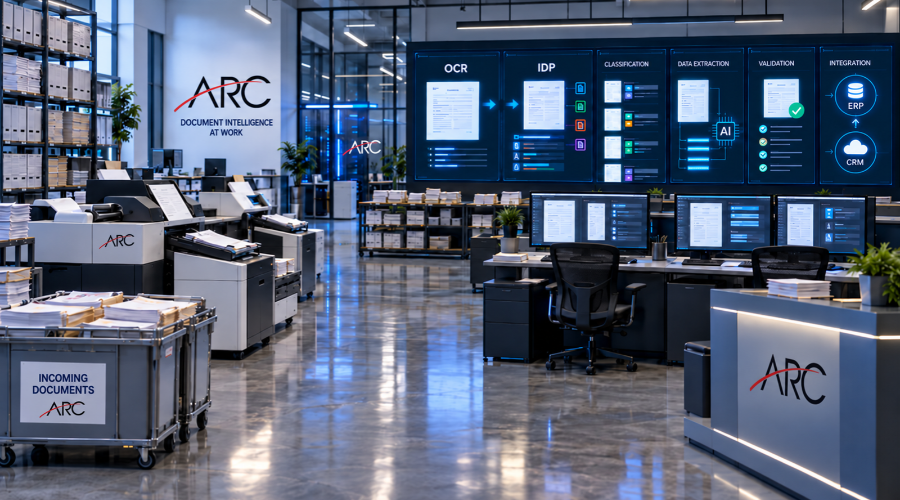
Artificial intelligence and machine learning have inspired a new generation of document solutions: Intelligent Document Processing. IDP starts where OCR ends, using advanced algorithms to not only recognize characters but also understand the context of information within a document. We deploy intelligent platforms that can extract tables, recognize handwriting, spot checkboxes, and even interpret different formats within complex documents.
Transitioning from OCR to intelligent document processing enables businesses to automate more of their workflow. For instance, rather than just pulling out a customer ID from a form, IDP can validate that ID against a database and route the document for approval – all without human intervention. This results in fewer errors, faster turnaround times, and improved accuracy across high-volume or multi-format jobs.
Key benefits of intelligent document processing include:
- Recognition of handwritten, mixed, or non-standard layouts – expanding automation to more document types
- Automatic data validation, minimizing costly manual checks and corrections
- Seamless integration with downstream systems like ERP or CRM, reducing time spent on data entry
- Learning from corrections, so the system becomes more accurate over time
These capabilities are especially valuable when processing documents that aren’t uniform, such as legal contracts, receipts, or complex architectural drawings. As a result, we help our clients achieve higher productivity and reduce the risks associated with manual handling.
Choosing the Best-Fit Solution: Strategic Factors & Business Benefits
For organizations evaluating OCR vs intelligent document processing, it’s important to match the technology to the business need. In scenarios where documents have consistent layouts and limited data fields, OCR may be the right choice. However, when faced with handwritten notes, varying templates, or large volumes of unstructured material, IDP presents clear advantages.
Our team sees firsthand how finance, healthcare, and legal sectors increasingly turn to intelligent document processing for compliance, speed, and efficiency. For example, processing insurance claims or medical records often involves handwritten or scanned forms. Intelligent automation extracts data accurately, triggers workflows, and reduces turnaround times for clients.
Additionally, integrating IDP solutions with existing enterprise systems boosts organization-wide efficiency. Automating data extraction and validation shrinks error rates and slashes operational costs. By moving beyond basic OCR to intelligent solutions, our clients unlock value that powers growth, especially as document volumes surge.
Selecting between OCR vs intelligent document processing depends on factors such as document complexity, required accuracy, and integration needs. Our ongoing support ensures clients receive guidance tailored to their unique requirements. As digital transformation accelerates, businesses equipped with modern document handling tools find themselves ahead in regulatory compliance and customer service.
Key Takeaways: Making the Smart Choice for Your Document Processing Needs
OCR vs Intelligent Document Processing: Aligning Technology with Business Goals
As our clients navigate changing demands in document management, understanding OCR vs intelligent document processing becomes more than a technical comparison – it’s a strategic decision that shapes workflow efficiency and data accessibility. While OCR remains valuable for simple extraction and digitization tasks, organizations seeking to handle a wider range of formats, unstructured documents, or higher data accuracy will find that intelligent document processing offers greater flexibility and automation. The decision comes down to the complexity of documents, compliance needs, and the scalability required as business needs evolve.
Translating Clarity Into Action
At ARC, we have seen firsthand how the right solution moves organizations beyond manual data entry and basic scanning. For straightforward digitization – like archiving printed invoices or contracts – OCR is often sufficient and offers fast results. But when our clients approach us with high volumes of forms containing mixed handwriting and print, or require critical data captured and validated for integration with ERP or CRM platforms, intelligent document processing minimizes manual effort, reduces risk of error, and supports regulatory compliance.
Planning Your Next Steps in Document Management
Selecting between OCR and intelligent document processing means thinking carefully about future business growth and the types of documents you need to manage. Start by assessing document volumes, complexity, and the potential impact on downstream workflows. We recommend a pilot phase – testing how each approach handles your real data and integrates with your existing systems. The ROI may come as measurable time savings, error reduction, or the ability to reallocate administrative resources to higher-value tasks. Whatever your goal – efficient archives, data-driven insights, or digital transformation – ARC’s experience in document imaging and graphic production ensures our team will deliver a tailored solution.
Let’s Drive Results Together
Whether you’re looking for basic document scanning or need to deploy advanced automation across distributed teams, our specialists can help you evaluate the options and map out a clear implementation roadmap. With ARC, your organization gains a partner committed to guiding you through every step – from assessment and pilot to full deployment and support. To learn more about how our document scanning and workflow automation services can improve productivity and information management, contact us for a consultation. We look forward to partnering with you as you choose the solution that’s right for your organization’s evolving needs.
FAQ
What is the difference between OCR and Intelligent Document Processing?
OCR, or Optical Character Recognition, is a technology that transforms printed or handwritten documents into machine-readable text. However, Intelligent Document Processing (IDP) takes this further by using AI and machine learning to interpret, categorize, and extract meaningful information from documents. As a result, IDP offers greater automation, accuracy, and adaptability for complex or varied content, making it more suitable for advanced business needs.
Can ARC’s solutions handle handwritten or complex document layouts?
Absolutely! While standard OCR can struggle with handwriting or intricate layouts, our Intelligent Document Processing solutions are designed to recognize and process various document types, including those with handwriting, mixed fonts, or complex structures. Because we leverage advanced AI, you benefit from improved accuracy across different input styles.
How does implementing IDP contribute to cost savings?
By automating time-consuming manual tasks like data entry, verification, and document sorting, our IDP solutions significantly reduce labor costs. Additionally, as fewer errors occur and documents are processed faster, your organization can streamline operations and reallocate resources where they are needed most. This leads to a measurable reduction in overhead expenses over time.
Is it possible to integrate your document processing with our existing systems?
Yes, our solutions are designed with compatibility in mind. We support integration with popular business systems such as ERP, CRM, and document management platforms. This seamless connectivity ensures that your workflows remain efficient and data moves smoothly between departments, enhancing overall productivity.
What industries benefit most from moving beyond OCR to IDP?
While every industry can gain from better document automation, sectors that manage large volumes of complex documents – like finance, healthcare, and legal – experience the greatest advantages. Our IDP solutions help these organizations achieve faster compliance, improved data accuracy, and better customer service by automating critical document workflows.
How secure is your document processing service?
We prioritize security at every stage of the document lifecycle. By employing robust encryption, access controls, and audit trails, our solutions meet or exceed industry standards for data protection. You can trust that sensitive information processed by ARC remains safe, supporting your organization’s compliance and confidentiality requirements.
Can we customize the document processing workflow for our unique needs?
Definitely! We understand that no two organizations are alike. Our team works closely with you to tailor workflows, validation rules, and automation triggers that align with your specific requirements. As your needs change, our flexible systems adapt to support new processes or document types.
What is involved in the implementation process for these solutions?
Our implementation process begins with a thorough assessment of your current workflows and objectives. Next, we set up and configure the selected solution for your environment, including needed integrations and customizations. We provide training to ensure your staff can use the system confidently. Finally, we offer ongoing support to optimize performance over time.
How does IDP improve compliance and reduce regulatory risk?
IDP automates the extraction, validation, and organization of critical data, making it easier to maintain up-to-date records and quickly retrieve documents during audits. Because our system reduces manual handling and enforces standardized processes, your organization can demonstrate greater control and accuracy – a key part of compliance in regulated industries.
What measurable improvements can our organization expect after adopting IDP?
Organizations that implement our IDP solutions often see a dramatic reduction in manual workload, faster turnaround times for document processing, and fewer data errors. Moreover, as your staff spends less time on routine tasks, they can focus on higher-value activities, which boosts both productivity and job satisfaction. Over time, these benefits translate into quantifiable ROI for your business.