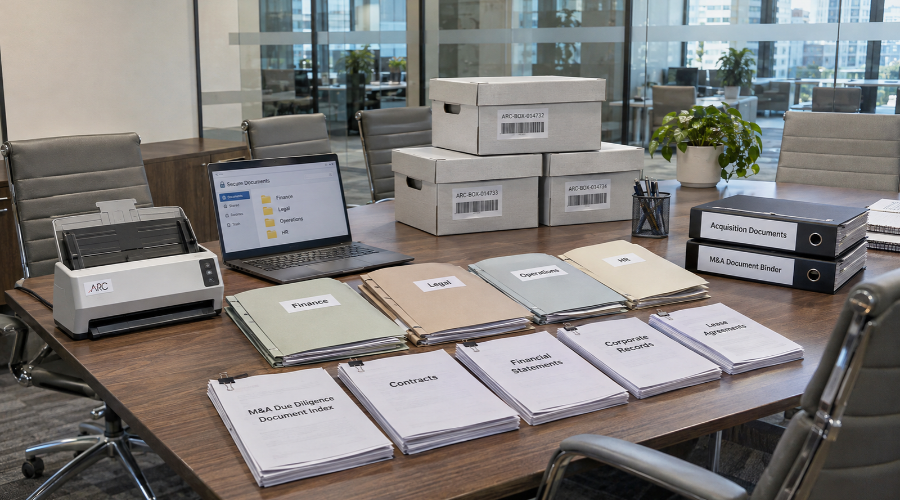
Why Now Is the Time for M&A Document Scanning Preparation
Mergers and acquisitions activity continues to climb across sectors, with organizations seeking growth, market expansion, and operational efficiency. As the pace and competitiveness of M&A heat up, due diligence teams and legal advisors need secure and reliable access to critical documentation – often within tight timelines. The accuracy, availability, and speed with which these records can be produced directly impact the timeline and outcome of any deal.
Many of the essential documents that underpin an M&A process – contracts, leases, policies, personnel files – are still housed in paper form. These physical files must be prepared and transitioned into virtual due diligence rooms to support disclosure requirements, document review, and efficient decision-making. Failing to have coherent, accessible records can lead to unnecessary delays or, worse, missed opportunities.
Unlocking the Value of Digital Transformation in M&A
Digital document management makes a clear difference during an M&A transaction. The shift from paper to digital files adds value by optimizing workflows, providing consistent information access to authorized teams, and reducing friction when remote collaboration becomes essential. Our document imaging and graphic production services help ensure your records are digitized accurately and securely, positioning you for seamless participation in virtual deal rooms.
The digital transformation is not only a matter of convenience – it’s also about mitigating risk. Documents that are securely scanned and stored allow for controlled sharing, robust tracking, and swift retrieval. With the right partner in scanning preparation, you gain a foundation for stronger compliance audits, easier regulatory review, and increased confidence in the M&A process.
The Stakes in Modern M&A Due Diligence
When organizations approach a transaction, the stakes for accuracy and confidentiality are high. Every document reviewed during due diligence must be reliable and complete, meeting both business and compliance expectations. According to Deloitte’s “The Due Diligence Imperative” report, teams that anticipate documentation needs and employ secure digitization set themselves apart during negotiations. Our M&A document scanning preparation services are structured to support this preparedness and maintain the integrity of your files.
Confidentiality and speed are also critical. Sensitive information must be protected from loss, unauthorized access, or inadvertent disclosure – all while enabling authorized stakeholders to move quickly. By planning ahead and preparing your paper records for digital presentation, you support more transparent, efficient, and compliant transactions.
The Benefits of M&A Document Scanning Preparation
How High-Volume Scanning and Indexing Support Compliance and Deal Success
- Minimizing lost documents by consolidating paper records into organized digital folders
- Helping ensure compliance with data retention laws, including requirements from the Sarbanes-Oxley Act
- Enabling teams to quickly search, retrieve, and share essential files, which streamlines communication and decision-making during due diligence
With HIPAA-compliant scanning services, our approach helps maintain confidentiality throughout every step. Secure digitization not only supports regulatory adherence but also meets expectations of buyers and legal counsel. As a result, every RFI or checklist from stakeholders can be answered faster, reducing costly delays. Virtual data rooms allow internal and external teams to view digital records securely in real-time. When everything is accessible instantly, the pace of deal-making can increase without sacrificing quality or accuracy.
Best Practices for Preparing Paper Records for an Acquisition Due Diligence Room
Planning and Execution Essentials
Initiating a well-structured scanning project is crucial in the overall M&A document scanning preparation. We start by developing a plan that fits your deal’s specific record requirements and deadlines. This step includes sorting paper records, removing duplicate materials, and categorizing documents based on deal relevance. Clearly defined categories prevent confusion later in the review process and help track progress as scanning proceeds.
Selecting the correct scanning resolution is equally important. It impacts file size, legibility, and compatibility with your virtual data room. Applying industry best practices during sorting and scanning ensures legal compliance and operational consistency.
Tagging, OCR, and Searchability
We use metadata tagging and OCR (optical character recognition) to enhance each document’s searchability and organization. According to studies from organizations like AIIM Market Intelligence, well-indexed, searchable files make due diligence rooms much easier to navigate. Metadata tagging helps map your physical archive to digital folders, while OCR ensures that scanned text remains accessible for quick keyword searches. These practices minimize time spent hunting for information and allow for smoother integration with modern data management systems.
Maintaining Chain-of-Custody and Quality Assurance
We know the importance of secure processes throughout every stage of scanning. Chain-of-custody procedures provide an auditable trail for critical materials, helping ensure document authenticity and trust among buyers, sellers, and advisors. After scanning, quality assurance checks confirm file integrity, accuracy, and legibility. By maintaining these controls, your team can trust that every scanned record matches its source and supports regulatory requirements.
Why Timing Is Critical for M&A Document Scanning Preparation
Deal timelines are often tight, and any delay with documentation may affect transaction value or close dates. Early scanning projects give internal teams ample time to address gaps and respond to buyer questions. Proactive M&A document scanning preparation can lead to fewer hurdles during negotiation and better alignment among all parties. By scanning records early, we help avoid last-minute document rushes and support a structured, strategic due diligence process. Transition teams can then focus on high-value analysis and communication rather than basic record retrieval, maintaining momentum throughout negotiations.
The Path Forward: M&A Document Scanning Preparation for Confident Closings
In an environment where time, accuracy, and control decide the pace and outcome of deals, M&A document scanning preparation is no longer optional. The ability to provide digital access to every needed document not only accelerates due diligence but also instills confidence among buyers, legal teams, and advisors. As we’ve outlined, our structured approach supports businesses looking to unlock the value of their paper records, bolster compliance, and ensure data security with every transaction.
Partnering for a Smoother M&A Process
Our experience demonstrates that when scanning and organizing begin early, stakeholders can spend less time chasing documents and more time focusing on negotiations. By anticipating the needs of the due diligence room, we help avoid last-minute scrambles and potential deal delays. For those in charge of acquisitions and divestitures, this proactive move means a higher chance of keeping the process on track – and reducing overall risk. Our focus on secure handling, regulatory protocols, and precise indexing enables transparency and easy oversight at every stage.
Leveraging Technology for Transformation
Shifting to digital workflows extends well beyond the M&A event itself. With searchable, organized digital files at your team’s fingertips, the benefits continue long after closing. Our processes, including metadata tagging and OCR, make future audits and information retrieval simpler. We recognize the trust involved in handling confidential material, and our chain-of-custody processes are built to share accountability and provide a clear history of document management. If you are looking for a wider range of digital solutions beyond M&A, our business document scanning services are designed to fit multiple operational needs.
The Value of Early Action
Waiting to digitize documents until due diligence is underway can add unnecessary strain and stress to an already intensive process. Our recommendation is always to start preparation well before the deal heats up. This approach leads to a clearer project timeline, reduces information bottlenecks, and raises the overall efficiency of your transaction. Ultimately, M&A document scanning preparation equips you and your team with the resources to respond quickly and decisively – traits that can make the difference in a competitive market.
Ready to Support Your Next Transaction
We stand ready to serve as your partner in preparing for transitions. Whether you require bulk scanning, advanced indexing, or secure digital storage, our services are adaptable to your needs and deadlines. Through our commitment to reliable procedures and customer security, we aim to add stability and predictability to the complex world of M&A. Preparing now means positioning your business for faster, more confident deal execution.
FAQ
What types of documents can ARC scan and digitize for M&A due diligence?
We scan and digitize a wide range of documents, including paper contracts, financial statements, personnel files, engineering drawings, blueprints, and confidential correspondence. Furthermore, our technology supports various paper sizes and file types, ensuring every record relevant to your merger or acquisition is securely transformed into high-quality digital files.
How does ARC ensure the security and confidentiality of my documents?
We understand that security is paramount during M&A transactions. Therefore, we employ strict chain-of-custody protocols, HIPAA-compliant processes, and advanced access controls at every scanning site. Our secure facilities and encrypted data transfers protect sensitive information from unauthorized access throughout the entire digitization process.
Can ARC customize the document organization and metadata tagging to fit specific M&A requirements?
Absolutely. We can tailor the organization of digital files and metadata tagging based on your unique needs or deal structure. Additionally, our team collaborates with your stakeholders to categorize records logically, apply relevant keywords, and enable robust searchability, greatly facilitating seamless due diligence reviews.
How does the scanning process minimize the risk of lost or misfiled documents?
Our comprehensive workflow includes meticulous sorting, careful duplication checks, and barcode tracking. As a result, every document is accounted for during the scanning and indexing stages. Ultimately, this approach substantially reduces the chance of misplacement, so you can trust the integrity of your digital record set.
What role does Optical Character Recognition (OCR) play in M&A document scanning?
OCR technology converts scanned images into searchable, editable text. This significantly enhances the usability of digital documents, allowing teams to quickly locate relevant information during due diligence. Because we apply OCR as a core part of our services, it adds tremendous value to your transition timeline and decision-making.
How fast can ARC complete a high-volume M&A scanning project?
The turnaround time depends on the volume and scope of your records. However, our specialized equipment and scalable workforce enable us to complete large-scale projects rapidly – often within days or weeks for comprehensive collections. Early initiation of the scanning process helps avoid bottlenecks and keeps your M&A timeline on track.
Are your scanning services compliant with regulations such as Sarbanes-Oxley or HIPAA?
Yes, we follow strict regulatory standards, including Sarbanes-Oxley for financial documentation and HIPAA for sensitive personal or medical records. In addition, our procedures support audit trails and access logs, further protecting your business during regulatory reviews and integration stages.
Can scanned and digitized documents be directly integrated into a virtual data room?
Certainly. We deliver digital files in formats compatible with most leading virtual data room platforms. Not only does this facilitate instant access for authorized parties, but it also accelerates the due diligence process by eliminating delays associated with physical handoffs or manual uploads.
What if my documents are in poor physical condition or include oversized plans?
No problem. Our advanced scanning systems and trained technicians can handle fragile, faded, or oversized documents such as architectural drawings. We take care to preserve document quality while digitally restoring clarity whenever possible, giving you the most accurate digital replica for your transaction.
How does ARC ensure quality and accuracy in scanned documents?
Every project is subject to multi-stage quality assurance, including visual checks, file audits, and metadata validation. If errors are detected, we promptly rescan and correct them so your archive remains both accurate and reliable. In summary, our focus on post-scan QA guarantees the integrity of your digital assets for M&A success.