What Is Bulk Document Scanning and Why Does Cost Matter Now?
Bulk document scanning is the process of converting large volumes of paper records into digital files for easier access, management, and preservation. For organizations weighed down by paper-based workflows – whether in finance, healthcare, education, or government – transitioning to digital documents is more relevant than ever. As we move further into 2026, the operational and strategic importance of digitization only continues to grow.
Understanding what goes into bulk document scanning cost has become a top priority for decision-makers. Budget planning, compliance requirements, and workflow efficiency are all directly tied to the investment needed for a scanning project. In today’s fast-paced information environment, the ability to accurately estimate and control these costs can directly impact the success of a digital transformation initiative. That’s why it’s so necessary to get this right from the start.
Many organizations underestimate how quickly paper can accumulate and bog down daily operations. As file cabinets, storerooms, and even offsite storage locations fill up, the burden becomes clear – not just in terms of space, but also in lost productivity and unmet compliance requirements. Digitization, especially when performed at scale, helps organizations regain control over their information and adapt to evolving standards for security and accessibility.
The Value of Professional Document Imaging and Graphic Production Services
Choosing to work with a team specializing in document imaging and graphic production services offers critical benefits for any organization pursuing digital transformation. Our processes are designed to ensure files are captured accurately and securely, so your data remains protected throughout the process. As more workflows migrate to digital platforms, accuracy and reliability matter just as much as cost savings.
Beyond the scanning itself, pairing document imaging with graphic production unlocks several opportunities. These can include improved searchability from optical character recognition (OCR), the creation of organized digital archives, and smoother collaboration among teams working in distributed environments. As a result, our clients often find they can serve customers faster, make informed decisions, and meet compliance obligations more efficiently.
Document imaging and graphic production services also support a wide range of documents and formats – everything from legacy records to architectural drawings or legal files. This flexibility helps ensure no critical information is lost in translation and that digital libraries accurately reflect the original records.
Addressing the Demand: The Current Landscape of Bulk Document Scanning Cost
The need for bulk document scanning is on the rise as organizations look for sustainable ways to future-proof their information management. Rising costs for onsite storage, compliance pressures, and changing workplace habits all drive demand – for both large batch projects and ongoing, scheduled scanning services.
Current market data, such as industry averages collected by AIIM, show that the cost for bulk document scanning typically falls between $0.07 and $0.15 per page for large-scale projects. These ranges provide a starting point, but every project has unique variables that affect the final investment. Factors such as document preparation, scanning quality, file output, and post-scan processing influence not just price, but the overall value you receive.
Given the increased need for access, compliance, and digital agility, understanding the drivers of bulk document scanning cost can help you plan effectively and avoid unexpected obstacles as you bring your records into the digital age.
Breaking Down Bulk Document Scanning Cost: What Influences the Price?
Core Factors That Impact Pricing for Bulk Scanning
Understanding bulk document scanning cost begins with a review of the main elements that affect the final price for scanning projects. The first is volume. As your quantity of documents increases, the price per page tends to decrease. This is due to economies of scale that benefit clients with large back files. On average, bulk jobs start around $0.07 per page, especially when batches exceed thousands of pages.
Another aspect is the physical condition of your documents. Clean, well-organized files are easier to process, saving considerable time. Conversely, damaged paper, staples, or mixed sizes require more manual labor, slightly raising the price. Therefore, it’s wise to spend time prepping materials before scanning begins.
The required level of indexing is also central to overall cost. If you want just a simple PDF scan, prices are lower. But if your workflow demands searchable files (OCR), detailed file naming, or sophisticated metadata tagging, those steps add complexity. While these premium services might increase costs, they also boost digital file usefulness for years to come.
Furthermore, file output preferences play a role. Some clients request scans in color, which takes more bandwidth to store and process than black and white options. Others specify secure file delivery, which can require encryption and additional labor.
To sum up, bulk document scanning cost will be shaped by:
- Project volume and page count
- Document preparation and condition
- Indexing or file naming detail
- Scanning modes (color, grayscale, or black and white)
- Special requirements (OCR, indexing, secure transfer)
If your project contains unique items like blueprints or bound books, we also adjust pricing to account for specialized handling or scanning hardware.
Best Practices to Maximize ROI on Document Imaging and Graphic Production
Clients often ask how they can manage bulk document scanning cost while increasing the value of their investment. One of the primary ways you can help lower costs is by preparing your documents in advance. We recommend removing staples, straightening papers, and grouping by size or type. By streamlining preparation, you enable our technicians to scan more efficiently. This not only saves time for our team but also minimizes the price for your organization.
Additionally, consider combining traditional scanning with advanced graphic production services. When files are organized with clear indexing or are made text-searchable using OCR, your digital archive becomes much more practical for retrieval in the future. This means you get more than just digital copies; you get a powerful database that supports compliance and everyday efficiency.
Clients who plan for long-term storage and retrieval often choose metadata tagging or custom folder structures. Although these options can marginally increase upfront investment, they often save many hours down the road. This highlights how a slightly higher initial bulk document scanning cost sometimes results in ongoing operational savings.
Real-World Applications: Where Cost-Effective Bulk Scanning Makes a Difference
Across industries, cost-effective bulk scanning supports a range of needs. For instance, healthcare organizations often scan medical records to meet audit and compliance standards. Educational institutions digitize student files or archives to protect records and allow for quick access. Construction or architectural firms may need to scan plans and large-format drawings to better collaborate and safeguard original blueprints.
Using our document imaging and graphic production solutions, clients gain secure backups, centralized storage, and improved workflow access. Even government agencies and law offices reduce physical file storage costs and improve information security with reliable digital archives. By considering both cost and value, organizations can build a digital transformation that meets their budget and ongoing needs.
Final Thoughts: Optimizing Bulk Document Scanning Cost
Navigating the path toward digital transformation starts with understanding the true impact of bulk document scanning cost. As organizations continue to shift from paper to digital, it’s important to choose a partner who values precision, efficiency, and secure handling of your records. At ARC, we’ve seen how tailored document imaging and graphic production services contribute to streamlined operations, whether you’re digitizing archive rooms, engineering plans, HR files, or student records. Our goal remains to enable you to realize the advantages of digital document management without hidden costs or inefficiencies.
How to Move Forward With Your Bulk Document Scanning Project
A successful transition begins with thoughtful preparation and clear communication about project goals and requirements. Take the time to organize your records, identify key priorities for digitization, and convey any special graphic production needs, such as OCR or detailed indexing. These steps help facilitate a smoother process and can support cost savings that align with your budget. Our team is prepared to help clarify your questions, provide realistic timelines, and deliver output formats that fit your workflow.
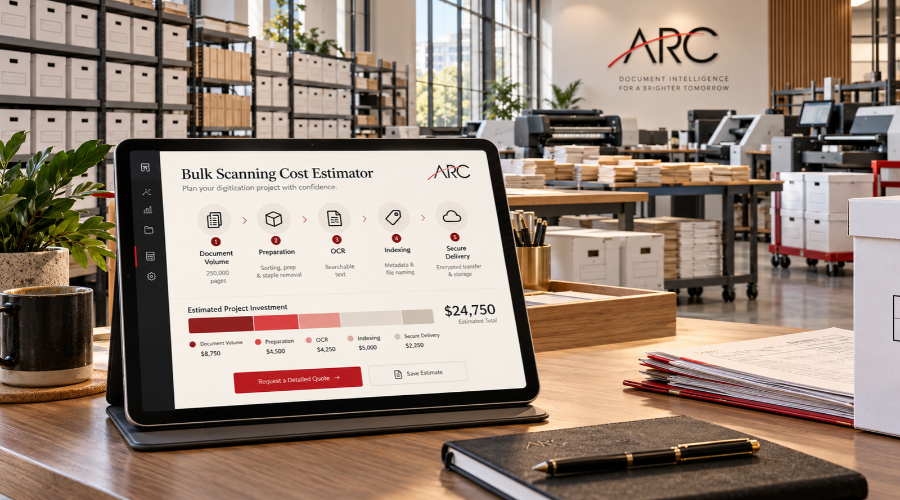
To help estimate your project investment, whether you’re scanning a few file cabinets or thousands of boxes, our scanning estimator offers a simple way to start. By inputting your specific project details, you can get a clearer sense of costs and see how different variables – like volume, file type, and processing options – might impact your final quote.
Building a Long-Term Advantage With Document Imaging
When digital files replace physical documents, organizations can achieve more than just savings on storage costs. Fast, secure access to digital records means improved response times, easier compliance, and increased collaboration – benefits that multiply over time. We encourage clients to view bulk document scanning cost as an investment in the quality, security, and accessibility of their information. Our document imaging and graphic production solutions are structured to provide reliable value, regardless of your project’s size or complexity.
If you’re considering a bulk scanning project, selecting a partner with proven experience can make all the difference. We support our clients with transparent pricing, careful project management, and an understanding of unique industry needs. By partnering with ARC, you remain in control of your information and your budget, with the confidence that your records are in capable hands. When you’re ready to get started, reach out – we’re here to guide you through each stage of your digitization journey.
FAQ
What factors determine the final cost of bulk document scanning?
The final cost of bulk document scanning is influenced by several key factors: the total page volume, document condition (such as staples, tears, or unusual sizes), required indexing detail, output file format, and any special handling like OCR or high-resolution graphic production. By understanding and preparing for these factors, organizations can more accurately estimate and control costs.
How can our organization prepare documents to reduce scanning costs?
Preparation is crucial for cost efficiency. We recommend removing staples, clips, and bindings, sorting documents by type or date, and ensuring pages are flat and legible. Notably, organized and pre-sorted material moves more seamlessly through the scanning process, which helps minimize labor charges and accelerates turnaround time.
Can we customize file output formats or indexing options?
Absolutely! We offer a range of file output formats including PDF, TIFF, JPEG, and fully searchable PDFs. Additionally, our indexing services are fully customizable, allowing you to search by keywords, dates, project numbers, or other relevant fields, which greatly enhances future retrieval and compliance efforts.
What is the typical turnaround time for bulk document scanning projects?
Turnaround time varies based on project size and specific requirements. However, most standard projects are completed within one to three weeks. By optimizing document prep and scheduling, our team works hard to meet urgent deadlines whenever possible.
Are there minimum volume requirements or built-in discounts for large projects?
Yes, our pricing model includes minimum volume thresholds, and we offer attractive volume discounts for larger batch projects. As the number of documents increases, the per-page cost typically decreases, helping you achieve greater value on large-scale scanning jobs.
Does document condition impact the overall scanning cost?
Document condition does play a role. Fragile, damaged, or unusually formatted documents may require extra handling and therefore can increase the cost. When possible, gentle pre-sorting and flattening of documents prior to scanning will streamline the process and may help control expenses.
How does adding graphic production or advanced imaging add value?
Incorporating graphic production – such as high-quality imaging, detailed indexing, and OCR (Optical Character Recognition) – offers benefits that extend well beyond basic scanning. These features not only support future searchability, but also improve regulatory compliance and ensure your digital archives are visually consistent and professional.
Do you ensure the security and confidentiality of sensitive information during scanning?
Yes, safeguarding your information is a top priority. Our processes are designed with comprehensive security measures including chain-of-custody controls, secure transportation, and certified destruction of originals if requested. Every step of our workflow emphasizes confidentiality and regulatory compliance.
What types of organizations benefit most from bulk document scanning and imaging?
Virtually any organization with large volumes of paper records can benefit, but our services are particularly popular with businesses, schools, healthcare providers, government agencies, and legal offices. Because digitization reduces physical storage needs and enhances access, it supports organizations of all sizes seeking increased efficiency.
What are the environmental and sustainability benefits of bulk document scanning?
Choosing bulk document scanning helps organizations reduce their reliance on paper, free up physical storage space, and minimize waste associated with long-term paper archiving. In the long run, digital records lower your overall environmental impact while supporting modern sustainability initiatives.